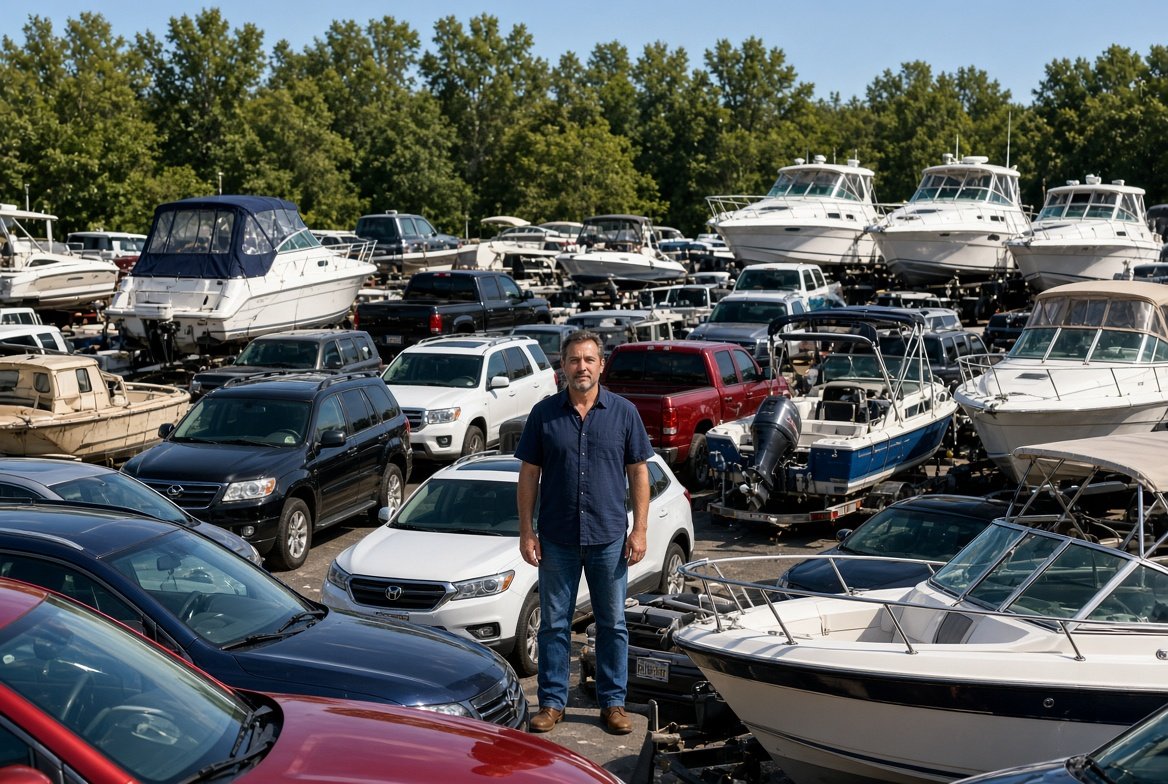
Image by GrokAI.
Okay folks, file this one under some of the things that trustees care about. That said, I really want you to read this post from a trustee’s perspective, not because we all need to accommodate the trustee’s positions on every issue, but because understanding their perspective helps to understand bankruptcy as a whole.
So let me also take this moment to tell you that my position of keeping or surrendering assets is case-specific. Maybe you can keep the Keystone, and maybe you can keep that third vehicle. Of course it should go without saying that if you own anything, then you need to consult a good attorney. If you want to talk to a great one, well… you know who to call.
When filing Chapter 7 bankruptcy, you want to keep as much property as possible. But there is a difference between protecting your hard-earned property and placing a death-grip onto an entire collection of vehicles, boats, and recreational toys while seeking to discharge your unsecured debts.
Trying to keep multiple cars (think three or more, although three is already a bad look in some districts), trucks, motorcycles, boats, RVs, ATVs, and other recreational vehicles can create problems in a Chapter 7 case. Some of those assets may have substantial nonexempt equity. Others may carry significant monthly loan payments. And even when the property can technically be retained, the overall financial picture may attract unwanted attention from the United States Trustee. Again, we’re looking through their eyes, not yours. If you have defensible reasons for wanting to hang onto recreational vehicles, then that helps a lot.
The Exemption Problem
Let's start with exemptions.
Bankruptcy exemptions protect certain property from liquidation by the Chapter 7 trustee. However, exemptions are subject to statutory limitations, and those limitations can become particularly important when a debtor owns multiple motor vehicles or recreational assets.
A debtor may have sufficient exemptions to protect the equity in one vehicle but find that protecting several vehicles, a boat, and an RV is considerably more difficult.
If property has nonexempt equity, the Chapter 7 trustee may have an economic incentive to liquidate it for the benefit of creditors.
The fact that a debtor has a loan against a vehicle does not automatically make the vehicle exempt. What matters is the property's value, the amount owed against it, and the exemptions available to protect the debtor's equity.
I have seen fact patterns where the debtor might have two boats, four cars and a fifth wheel, all of which have had significant equity. If that person also has a ton of debt, the question turns to whether letting a trustee liquidate those assets, or whether it is better for that person to just sell those items and pay off any liens. If you go that latter route, you have to ask yourself what options you have with respect to the proceeds. See how this works? For goodness sake, don’t make big moves without talking to an attorney.
What also draws scrutiny:
There is another issue that deserves attention: the overall financial picture presented by the bankruptcy filing.
Consider a debtor who owns several financed vehicles, a boat, and an RV. The debtor is making substantial monthly payments on these assets while seeking to discharge thousands of dollars in credit card debt and other unsecured obligations.
How might that look to the United States Trustee? What problems could that create.
The concern is not simply that the debtor owns multiple vehicles. It is that the debtor may be maintaining an expensive lifestyle while asking the bankruptcy system to relieve them of their unsecured financial obligations.
This can become particularly important in cases involving below-median-income debtors.
Being below the applicable median income means that the debtor does not have to complete the presumption-of-abuse means test under 11 U.S.C. § 707(b)(2). But that does not mean every below-median-income Chapter 7 case is immune from scrutiny.
Under 11 U.S.C. § 707(b)(3), the court may consider whether the filing was made in bad faith or whether the totality of the debtor's financial circumstances demonstrates abuse.
Maintaining substantial payments on multiple vehicles and recreational assets can become part of that broader inquiry. I’ve read plenty of motions to dismiss (not on my cases!) where the US Trustee specifically singles out monthly payments on extraneous vehicles as reason for the court to dismiss the case.
“Passing” the Means Test Isn't the Whole Story
For debtors who are above median income, secured debt payments can play an important role in the means-test calculation. The statutory treatment of those payments is governed by specific rules.
But even where a debtor qualifies for Chapter 7 relief under the means test, that calculation does not necessarily end the inquiry.
And for below-median-income debtors, the absence of a means-test presumption does not eliminate the possibility of a challenge under § 707(b)(3).
The distinction is important. A debtor's ability to qualify under the statutory means test, where applicable, is not necessarily the end of the analysis of whether Chapter 7 relief is appropriate.
Sometimes Surrendering Is a Good Look
There is nothing particularly unusual about surrendering a financed vehicle in Chapter 7 bankruptcy. The bankruptcy process provides a mechanism for dealing with secured debts, including surrendering collateral and addressing resulting deficiency claims. Who doesn’t want to unburden themself of ridiculous interest rates and those pesky monthly payments?
Surrendering a vehicle or recreational asset may also eliminate substantial ongoing expenses, including loan payments, insurance, maintenance, registration, storage, and repairs.
By contrast, attempting to retain multiple financed vehicles, boats, and recreational assets while seeking to discharge unsecured debt can raise questions that might otherwise never arise. From my perspective, though, the question is what problems can bankruptcy actually solve? From my perspective, it’s not about how things look to the trustees, but about how a debtor finds actual relief in a way that is defensible and that makes sense.
None of this means that owning multiple vehicles automatically makes someone ineligible for Chapter 7 bankruptcy. Nor does it mean that every financed recreational asset will result in a dismissal or trustee challenge.
But it is worth understanding that the U.S. Trustee may look at the bigger picture, not simply whether a debtor technically qualifies for Chapter 7 relief.
The Bottom Line
Chapter 7 bankruptcy involves more than determining whether property can be exempted or whether a debtor can continue making monthly loan payments.
Multiple vehicles, boats, RVs, and other recreational assets can create exemption issues, substantial ongoing expenses, and questions about the debtor's overall financial circumstances.
A bankruptcy filing that appears to preserve an expensive lifestyle while eliminating unsecured debt may invite scrutiny from the U.S. Trustee.
Surrendering is not necessarily a bad outcome. Sometimes, it is a good look.’
Even better: surrendering also makes life less expensive.
Now don’t freak out. We do free consults.
Disclaimer: This article is provided for general informational and educational purposes only. It is not legal advice and does not create an attorney-client relationship. Every bankruptcy case is different, and the treatment of vehicles, boats, recreational assets, exemptions, and potential dismissal under 11 U.S.C. § 707(b) depends on the particular facts and applicable law. Nothing in this article should be interpreted as a recommendation to retain or surrender any particular property. Consult a qualified bankruptcy attorney regarding your individual circumstances